
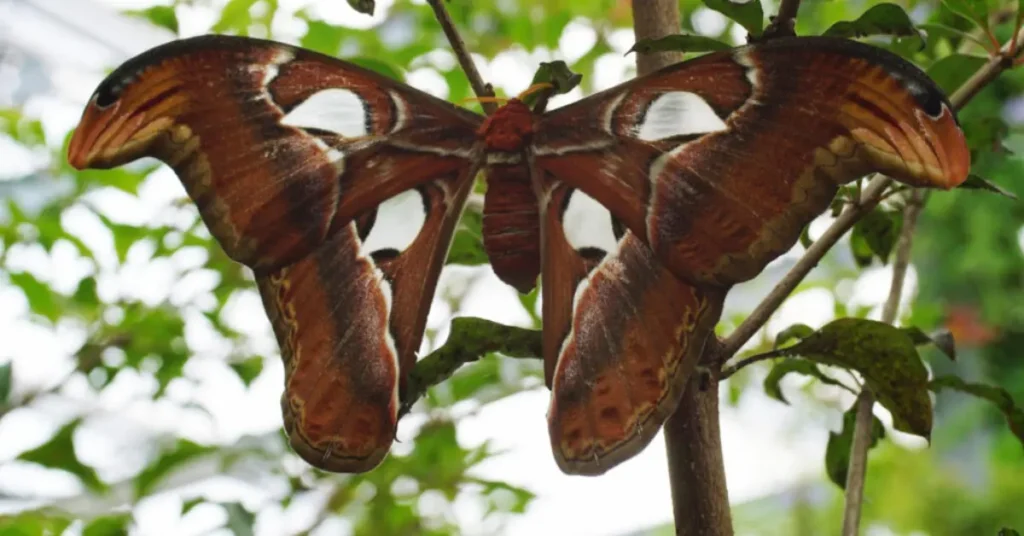
The Cecropia Moth (Hyalophora cecropia) is considered largest moth in North America, This belongs to Saturniidae members that members of which are commonly named the saturniids. These Cecropia Moth also known as gaint silk moths. Females have recorded wingspan of 5–7 inches (13–18 cm).
These moths are mostly found in the eastern parts of North America. However, they can also be seen as far west as Washington and across many areas of Canada. Cecropia moth caterpillars usually live on maple trees, but they also feed on cherry, birch, and several other types of trees. This species was first identified and described by Carl Linnaeus in 1758.
Hyalophora cecropia plays an essential role in forest ecosystems.
Key Specifications of Cecropia Moth (Hyalophora cecropia)
| Specification | Details |
| Scientific Name | Hyalophora cecropia |
| Common Name | Cecropia Moth (Hyalophora cecropia) |
| Family | Saturniidae (giant silk moths) |
| Wingspan | 5–7 inches (13–18 cm) the largest native moth in North America |
| Appearance | Reddish-brown wings with white crescents and red, white, and black borders |
| Habitat | Deciduous forests and wooded edges across North America |
| Diet (Adult) | None adults do not eat; they live on stored larval energy |
| Larval Host Plants | Maple, birch, cherry, apple, lilac, and other hardwood trees |
| Lifespan | Egg to adult: about 10–12 months; adult lifespan: 1–2 weeks |
| Behaviour | Nocturnal; uses pheromones to locate mates |
| Conservation Status | Not endangered but locally affected by habitat loss and parasitoids |
Habitat & Range
Across their wide range, cecropia moths live in temperate forests in both rural and urban areas. They are usually found on young hardwood trees. These moths can often be seen in backyards, orchards, along fence lines, in new housing areas, and in wooded places. While some cecropia moth cocoons are found on the branches of deciduous trees, most are located below the trees in clumps of grass or shrubs. This location likely helps protect them from predators. There is no recorded information about the elevation at which this species lives.
Life Cycle & Reproduction
The life of the Cecropia Moth (Hyalophora cecropia) is dramatic and fascinating:
Like other giant silk moths, adult cecropia moths do not have working mouthparts or a digestive system. Because of this, they do not eat and live for only about two weeks.
To find a mate, the female releases a special scent called pheromones. Male moths can sense this smell with their sensitive antennae from very far away sometimes up to a mile. While searching, a male may fly several miles. Mating usually starts early in the morning and can continue until evening.
After mating, the female lays up to 100 eggs. The eggs are reddish-brown and are usually placed on both sides of a host plant’s leaves. After hatching, tiny black caterpillars emerge. The caterpillars go through five growth stages, each lasting about a week. In the first stage, they are black and covered with small black hairs. They feed on common trees and shrubs such as maple, birch, and apple. As they grow, their color changes from yellow-green to bluish-green. In later stages, they become very large, and the raised bumps on their bodies turn blue, yellow, or orange. By autumn, the caterpillars are fully grown and reach about 4 to 4.5 inches in length.
Once fully grown, the caterpillars spin large brown cocoons on trees or wooden surfaces. The adult moths emerge in early summer during warm weather. Cecropia moths produce only one generation each year.
Adult cecropia moths are large, with wingspans usually between 5 and 7 inches. Their wings are brown with red coloring near the base and crescent-shaped red spots with pale centers. The hind wings have larger spots. The body is hairy, with reddish tones near the head that fade to lighter colors. The abdomen has alternating red and white bands.
- Egg Stage – Females lay eggs about 100 – 200 on host tree leaves in late spring or early summer. Eggs hatch in about 8 to 10 days.
- Larval Stage (Caterpillar) – Bright green caterpillars eat large amounts of their host plants and grow by shedding their skin several times during the summer.
- Pupa Stage – By autumn, the caterpillar spins a tough silk cocoon attached to a branch, where it overwinters.
- Adult Stage – In late spring, adults emerge to mate and reproduce. They lack functional mouthparts, so they do not feed and live only 1–2 weeks
Appearance & Adaptations
The Hyalophora cecropia is easily recognized by:
- Large size with striking reddish-brown wings edged in black, white, and red.
- White crescent-shaped spots centered on each wing.
- Feathery antennae, with males having larger, more plumose antennae to detect female pheromones from long distances.
These features make it a standout even among giant silk moths.
Ecological Importance
Though adult moths do not feed, their caterpillars provide food for birds and small mammals, supporting local biodiversity. By feeding on a variety of tree species, Cecropia Moth (Hyalophora cecropia) larvae help recycle nutrients within forest ecosystems.
Conservation & Threats
While not officially endangered, the Cecropia Moth (Hyalophora cecropia) faces several threats:
- Habitat loss from urban expansion.
- Light pollution, which disrupts mating.
- Parasitoid flies introduced to control invasive gypsy moths, which can harm native silk moths.
Gardeners can help by reducing pesticide use, planting host trees, and limiting outdoor lights during peak flight season.
FAQs about Cecropia Moth (Hyalophora cecropia)
Q1. How big is the Cecropia Moth?
The Cecropia Moth (Hyalophora cecropia) has a wingspan of 5–7 inches (13–18 cm), making it the largest native moth in North America.
Q2. Does the Cecropia Moth eat as an adult?
No. Adult cecropia moth caterpillar individuals lack functional mouthparts and live entirely off energy stored as caterpillars.
Q3. Where can you find them?
They inhabit deciduous forests and wooded areas throughout the United States and southern Canada.
Q4. How long do cecropia moth live?
Adults live only 1–2 weeks, focusing exclusively on reproduction.
Q5. What can gardeners do to help?
Planting host trees like maple, birch, cherry, or apple and reducing pesticide use can create safe habitats for the Cecropia Moth (Hyalophora cecropia).


