
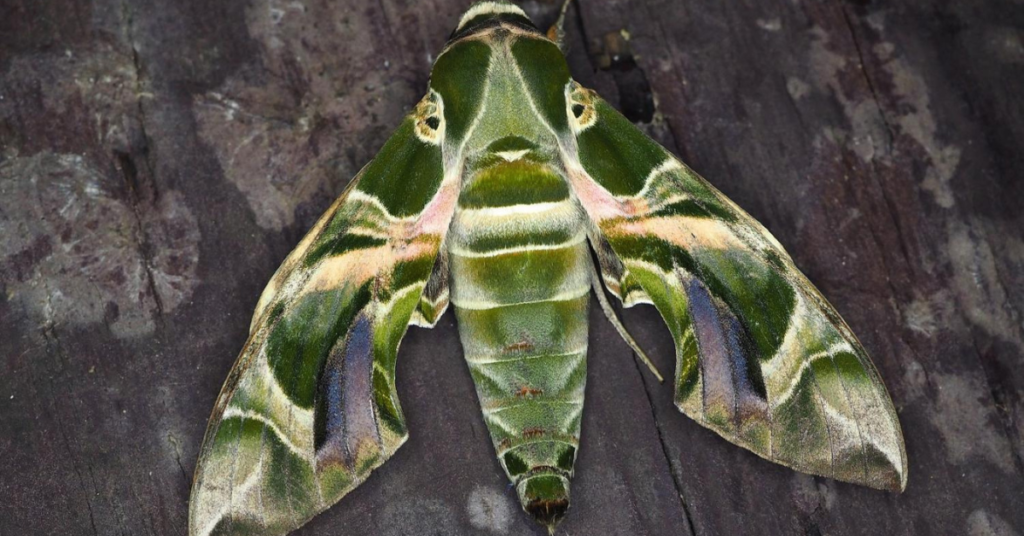
The Oleander Hawk Moth (Daphnis nerii) is one of the world’s most spectacular hawk moths, celebrated for its lush green camouflage and elegant pink-and-cream patterns. This powerful flier migrates over long distances across Africa, Asia, and southern Europe, adding vibrant beauty to gardens and wild habitats.
With a wingspan of up to 13 cm (5 inches), the Oleander Hawk Moth (Daphnis nerii) is not only visually stunning but also plays an essential role in pollination, especially for night-blooming flowers.
Key Specifications of Oleander Hawk Moth (Daphnis nerii)
| Specification | Details |
| Scientific Name | Daphnis nerii |
| Common Name | Oleander Hawk Moth (Daphnis nerii), Army Green Moth |
| Family | Sphingidae (hawk moths) |
| Wingspan | 9–13 cm (3.5–5 inches) |
| Appearance | Olive-green wings with pink, cream, and brown swirls creating a camouflage effect |
| Habitat | Tropical and subtropical regions of Africa, Asia, Middle East, and southern Europe |
| Diet (Adult) | Nectar from fragrant night-blooming flowers like jasmine and petunia |
| Larval Host Plants | Oleander (Nerium oleander), periwinkle (Catharanthus), desert rose (Adenium), and related species |
| Lifespan | Egg to adult ~30–40 days; adult lifespan 2–3 weeks |
| Behaviour | Strong nocturnal flier; capable of long-distance seasonal migrations |
| Conservation Status | Widespread and stable across its range |
Habitat & Range
The Oleander Hawk Moth (Daphnis nerii) is native to Africa and Asia but migrates seasonally into southern Europe and the Mediterranean during warmer months. Its preferred habitats include gardens, woodlands, and scrublands rich in flowering plants and oleander bushes, which provide both nectar and host plants for caterpillars.
Life Cycle
The life of the Oleander Hawk Moth (Daphnis nerii) is a marvel of transformation:
- Egg Stage – Females lay pale green eggs on the underside of oleander leaves; eggs hatch in about 4–6 days.
- Larval Stage – Caterpillars are bright green with blue-and-white eye spots near the head, helping deter predators. They feed heavily on oleander leaves for about 2–3 weeks.
- Pupa Stage – Mature larvae burrow into soil or leaf litter to form brown pupae, where they remain for 2–3 weeks.
- Adult Stage – Adults emerge with striking camouflage wings and live about 2–3 weeks, feeding on flower nectar and reproducing.
Appearance & Adaptations
The Oleander Hawk Moth (Daphnis nerii) is renowned for its lush, olive-green wings decorated with pink, cream, and brown swirls, creating a natural camouflage that blends with foliage. Its strong, narrow wings and powerful muscles allow it to hover like a hummingbird, visiting flowers for nectar at night.
Caterpillars exhibit false eye spots, a defensive adaptation that startles predators such as birds and reptiles.
Ecological Role
The Oleander Hawk Moth (Daphnis nerii) is an important night-time pollinator, particularly for long-tubed flowers like jasmine and petunia. Its larvae feed on oleander and related plants, naturally pruning vegetation and supporting the food web for birds and small mammals.
Coscinocera hercules Moth Life Cycle and Behavior
Conservation & Threats
Currently not endangered, the Oleander Hawk Moth (Daphnis nerii) remains widespread. However, pesticide use and habitat loss can locally impact populations. Providing nectar-rich gardens and avoiding chemical pesticides help sustain this species.
FAQs about Oleander Hawk Moth (Daphnis nerii)
Q1. Where is the Oleander Hawk Moth found?
It is native to Africa and Asia, with migratory populations reaching southern Europe and the Mediterranean during warm seasons.
Q2. What do adults eat?
The Oleander Hawk Moth (Daphnis nerii) feeds on nectar from fragrant night-blooming flowers such as jasmine and petunia.
Q3. What do the caterpillars feed on?
The larvae primarily feed on oleander leaves, but also on plants like periwinkle and desert rose.
Q4. How long does it live?
The adult Oleander Hawk Moth (Daphnis nerii) typically lives 2–3 weeks, while the full life cycle lasts about 30–40 days.
Q5. Why is it called the “Army Green Moth”?
Its green camouflage wings with pink and brown patterns resemble military camouflage, giving it the nickname “Army Green Moth.”


